DGX Spark vs RTX Pro 6000: When to Step Up From a Spark (and Where N1X Fits)
TL;DR: The DGX Spark and the RTX Spark's N1X are the same chip (128 GB at 273–300 GB/s), so choose between them by direction: Linux and clustering, or Windows personal AI. Step up to an RTX Pro 6000 (96 GB at 1,792 GB/s) when your model fits in 96 GB and you need 5–6× faster decode, quicker fine-tunes, or pro graphics.
Last updated: October 2026. Benchmarks are third-party (NVIDIA Developer Forums, Hugging Face community datasets, OpenZeka, Petronella Technology Group) and dated inline. Re-check current software before you buy.
DGX Spark vs RTX Pro 6000 is a choice between two bottlenecks. The DGX Spark has the bigger tank (128 GB unified memory); the RTX Pro 6000 has the faster pipe (6.6× the bandwidth, 96 GB). The N1X in RTX Spark laptops and mini-PCs is the DGX Spark's chip, so it sits on the Spark side.
The Short Version
Two questions decide it, in this order:
- Capacity vs bandwidth: do you need a bigger tank or a faster pipe?
- If you stay on Spark, which direction: inward (DGX Spark) or outward (RTX Spark / N1X)?
- Stay on Spark (capacity) if… the working set needs more than 96 GB on one box, or you want two DGX Sparks clustered into a 256 GB pool (NVIDIA clustering, up to about 405B parameters at FP4 across the pair).
- Choose DGX Spark if… your work faces inward: DGX OS on Ubuntu, ConnectX-7 clustering, prototypes that move to rack CUDA unchanged.
- Choose RTX Spark (N1X) if… your work faces outward: Windows 11 on Arm, a laptop or mini-PC, personal agents and creative apps. No announced configuration has ConnectX-7.
- Step up to RTX Pro 6000 if… the model already fits in 96 GB and speed is the gate: interactive decode, LoRA and fine-tune wall-clock time, rendering, or MIG. It has 96 GB of GDDR7 at 1,792 GB/s.
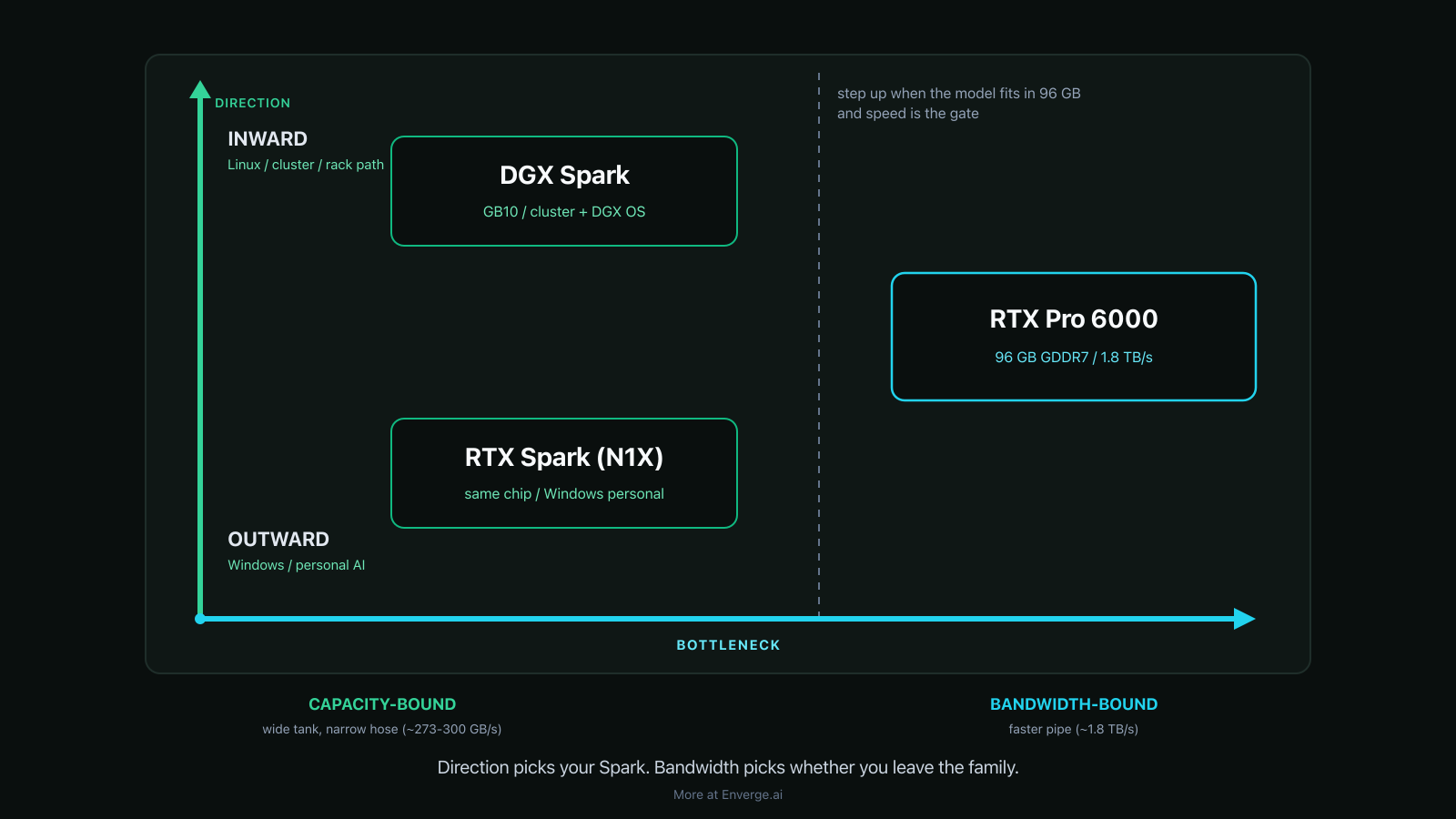 Direction picks your Spark. Bandwidth picks whether you leave the family. More at Enverge.ai
DGX Spark vs RTX Spark (N1X) vs RTX Pro 6000: specs side by side
The DGX Spark and RTX Spark share one chip, so their columns differ only in the machine around it. The RTX Pro 6000 is a discrete workstation card with a different memory architecture: less capacity, much more bandwidth.
| DGX Spark (GB10) | RTX Spark (N1X) | RTX Pro 6000 Blackwell | |
|---|---|---|---|
| Chip | GB10 Grace Blackwell | N1X (same silicon as GB10) | Discrete Blackwell GPU |
| GPU cores | 6,144 CUDA | Up to 6,144 CUDA (5,120 SKUs exist) | 24,064 CUDA |
| Memory | 128 GB LPDDR5X, unified | Up to 128 GB LPDDR5X, unified | 96 GB GDDR7 ECC |
| Memory bandwidth | 273 GB/s | ≈300 GB/s (OEM grades) | 1,792 GB/s |
| OS / stack | DGX OS (Ubuntu), rack-shaped CUDA | Windows 11 on Arm | Your host's OS (Linux or Windows) |
| Clustering | ConnectX-7, two units into 256 GB | None announced | Multi-GPU in a host; no Spark pool |
| Form / power | Mini desktop, 240 W external PSU | Laptops, 2-in-1s, mini-PCs | 600 W card plus a workstation host |
Is the N1X the same chip as the DGX Spark?
Yes. NVIDIA CEO Jensen Huang has said on record that the GB10 in the DGX Spark and the N1/N1X in RTX Spark systems are the same silicon (Tom's Hardware): a 20-core Grace CPU, a Blackwell GPU with up to 6,144 CUDA cores, up to 128 GB of unified memory, and about 1 petaFLOP of sparse FP4.
OEM SKUs can bin lower. NVIDIA's RTX Spark device-ID table lists both 6,144-core and 5,120-core N1X variants.
The RTX Spark's roughly 10% bandwidth bump (273 → about 300 GB/s) is real, but it stays in the same LPDDR5X class. It does not change which workloads feel fast. The full direction argument is in DGX Spark vs RTX Spark. This post picks up where that one stops: when neither Spark's memory pipe is enough.
Will your model fit in the RTX Pro 6000's 96 GB?
Check memory before speed. Weights, KV cache, and runtime overhead all have to fit on the device that serves them. A dense Llama 3.3 70B-class model needs about 140 GB at FP16, so it does not fit in 96 GB. The same model at FP8 (about 70 GB) or 4-bit (about 35 GB) usually does, with room left for KV cache. Mid-size dense models such as Gemma 4 31B or Qwen 3.6 27B are lighter: BF16 weights are about 50–62 GB before KV.
A rough rule of thumb for dense weights alone, before KV cache and framework overhead:
| Precision | Bytes per parameter | Dense ≈70B weights (ballpark) |
|---|---|---|
| FP16 / BF16 | 2 | ≈140 GB |
| FP8 / INT8 | 1 | ≈70 GB |
| 4-bit (Q4 / NVFP4-class) | ≈0.5 | ≈35 GB |
What that means on one card:
- A dense ≈70B at FP16 (about 140 GB) does not fit in 96 GB of GDDR7. A 128 GB Spark, or two DGX Sparks pooled, is still the capacity answer. The other option is offloading layers, and that collapses throughput.
- The same ≈70B at FP8 or 4-bit often fits under 96 GB with room for KV cache. Then the RTX Pro 6000 is eligible. Capacity no longer rules it out, so bandwidth becomes the deciding factor.
- MoE models complicate the table because active parameters are far fewer than total parameters (Gemma 4 26B-A4B, Qwen 3.6 35B-A3B, Qwen3.8-Flash-Next). The question stays the same: what has to stay resident on the GPU at your real context length?
Write the budget for your checkpoint and context window, not the parameter count on the model card. If it comes out above 96 GB and you have no multi-GPU plan, stay with Spark capacity. If it comes out under, keep reading. For a fuller model-by-model list, see what fits in 128 GB on a DGX Spark.
How many tokens per second does a DGX Spark do?
On dense mid- and large-size models, often single digits to low teens. Recent community and forum measurements (2026) tell a consistent story: the LPDDR5X pipe, not the model year, sets the ceiling.
| Workload (decode, batch 1 unless noted) | DGX Spark / GB10 | Source |
|---|---|---|
| Gemma 4 31B dense, runtime FP8 (vLLM) | ≈6.5 tok/s | NVIDIA Developer Forums (Apr 2026) |
| Gemma 4 31B dense, Q4_K_M (llama.cpp) | ≈10.7 tok/s | nabe2030/dense-27b-31b-dgx-spark (Apr 2026) |
| Qwen 3.6 27B dense, Q4_K_M (llama.cpp) | ≈11.9 tok/s | Same repo |
| Qwen3.8-Flash-Next (MoE; Engram table offloaded) | ≈28.5 tok/s | OpenZeka (vs 155.8 on Pro 6000) |
| Llama 3.3 70B (Ollama / community) | ≈4.7 tok/s | Hugging Face G3nadh/dgx-spark-benchmarks; similar ≈4.9 on OscarActual/gb10-llm-benchmark |
| Llama 3.3 70B Instruct FP8 | ≈3 tok/s class | NVIDIA forums (expected bandwidth ceiling) |
Model-year note: Meta's current open line is Llama 4 (Scout / Maverick, MoE). Llama 3.3 70B is still the dense ≈70B text yardstick with the clearest published Spark decode numbers; it is not Meta's newest flagship. On the Qwen side, Qwen3.8-Flash-Next (Aug 2026) is newer than Qwen 3.6 and is the cross-box MoE example above.
MoE is kinder to the Spark because decode cost tracks active parameters. Gemma 4 26B-A4B is about 23–25 tok/s on one Spark in forum Ray/vLLM posts. Qwen3.8-Flash-Next's ≈28.5 tok/s on Spark is the same pattern: sparse activation plus an Engram lookup table kept off the GPU path.
Treat every absolute as a snapshot of a stack (vLLM, llama.cpp, Ollama, quant recipe). Unified memory gets you past the VRAM limits that stop a 24 GB or 32 GB card; once the model loads, tokens per second is what you notice. Dense Gemma 4 31B at about 6.5 tok/s FP8, or Llama 3.3 70B in the mid-single digits, is usable for experiments and slow for interactive chat.
Aside on prefill vs decode: prompt processing (prefill) is closer to compute-bound, so a Spark can look fine on a long paste. Token generation (decode) on a dense model is memory-bandwidth bound, because every new token reads the resident weights again. The LPDDR5X ceiling shows up while the reply is being written, not when the model loads. That is why buyers who stop at "it fits" get surprised. The full explanation is in DGX Spark prefill vs decode.
Buying the other Spark does not fix decode. The RTX Spark's 300 GB/s configurations sit right next to the DGX Spark's 273 GB/s. Both have a wide tank and a narrow hose. The RTX Pro 6000 is the reverse: a smaller tank and a much faster hose.
How much faster is the RTX Pro 6000 than a DGX Spark?
About 5–6× faster single-user decode on models that fit in both, in third-party tests, close to the 6.6× bandwidth ratio on paper. The RTX PRO 6000 Blackwell Workstation Edition moves 1,792 GB/s from 96 GB of GDDR7 ECC. The DGX Spark moves 273 GB/s.
Petronella Technology Group's GB10 vs RTX Pro 6000 runs (May 2026; NVFP4 on vLLM, single user, 2,000 output tokens):
| Model | RTX Pro 6000 | GB10 (DGX Spark chip) | Ratio |
|---|---|---|---|
| Mistral Small 3.2 24B dense | 71.4 tok/s | 12.5 tok/s | 5.7× |
| Gemma 4 31B dense | 37.7 tok/s | 6.6 tok/s | 5.7× |
| Gemma 4 26B-A4B MoE | 161.5 tok/s | 29.2 tok/s | 5.5× |
Same OpenZeka Qwen3.8-Flash-Next run on the RTX Pro 6000: 155.8 tok/s (about 5.5× the Spark's 28.5; short 128/128 prompts, CordatusAI tool). The Engram table is offloaded so the model can run past the raw VRAM sticker on both boxes.
Petronella notes that its RTX Pro 6000 stack fell back to a weight-only dequant path instead of native FP4 kernels, while the GB10 ran native NVFP4. If anything, the gap may be a little wider on tuned software.
The trade-offs:
- 96 GB is a hard ceiling for resident weights. A dense Llama 3.3 70B at FP16 (about 140 GB) still needs Spark capacity or multiple GPUs. Large MoEs may need offload tricks (as with Qwen3.8-Flash-Next) on either box.
- No ConnectX-7 Spark pool, and not a quiet desk box. The card alone draws 600 W and needs a workstation host. The DGX Spark runs on a 240 W external supply.
- For models that fit, you get interactive tok/s, shorter LoRA and fine-tune runs, MIG slices, and workstation ray tracing.
The RTX Pro 6000 is not a better Spark. Its bottleneck is in a different place.
Is the DGX Spark fast enough for LoRA and fine-tuning?
For experiments, yes. When steps per hour matter, it is slow. LoRA and QLoRA runs stream enough weights and activations that the DGX Spark's 273 GB/s shows up as hours on the clock. If the fine-tune fits in 96 GB, as many image and mid-size LLM LoRAs do, an RTX Pro 6000 shortens the run.
LocalLLaMA threads put it bluntly: Sparks have room for experiments but are "slow by design" for training. It is the same bandwidth limit as decode, applied to a job you leave running overnight.
For a concrete number from the other side: on Enverge we timed a Qwen-Image LoRA on an RTX Pro 6000 at about 1,192 steps per hour, a projected 6.7 hours for 8,000 steps. The method and bills are in Is renting an RTX Pro 6000 cheaper than training on your 3090?. That post compares renting and owning on the Pro 6000; it is not a Spark comparison. Use it as an example fine-tune, then time your adapter on both machines you are considering. For the Spark side, see how to fine-tune an LLM on DGX Spark.
Rule of thumb: if the base model is too big, choose Spark (or a cluster) first. If the adapter job fits and you are waiting on the clock, leave the Spark family for bandwidth.
DGX Spark, N1X, or RTX Pro 6000: which should you choose?
Ask about capacity first, then direction, then speed.
- Does it fit in 96 GB? Do the memory budget above. If not, and you are not ready for multiple GPUs, choose Spark capacity or two DGX Sparks. The RTX Pro 6000 cannot create headroom it does not have.
- Staying on Spark: which way? Inward (Linux, clustering, path to rack hardware) means DGX Spark. Outward (Windows, personal AI) means RTX Spark / N1X.
- It fits and you are still waiting? Interactive decode in the low single or double digits of tok/s, LoRA or fine-tune runs that take days, MIG, or heavy 3D all point to the RTX Pro 6000.
| If you are… | Lean toward |
|---|---|
| Need more than 96 GB, or a dual-Spark 256 GB pool | DGX Spark (capacity) |
| Prototyping for rack hardware, may cluster | DGX Spark |
| Running local agents on the Windows machine you use every day | RTX Spark (N1X) |
| Choosing between 273 and 300 GB/s | Same class; don't rank on it |
| Running a model or LoRA that fits in 96 GB, where time matters | RTX Pro 6000 |
If your next step up is past a single workstation card, toward H100 or H200 class hardware, see DGX Spark vs H100 vs H200.
Can you try a DGX Spark or RTX Pro 6000 before buying?
Yes. Rent both by the hour and run your own workload. Load the model or adapter job you plan to ship, and see whether it runs out of memory or just runs slowly.
- Spark capacity / direction: rent a DGX Spark on Enverge from $0.75/hour (2× DGX Spark with a 256 GB pool: $1.65/hour), SSH and Docker on real GB10 hardware.
- Bandwidth step-up: How to Rent an RTX Pro 6000 on Enverge, from $1.95/hour, billed by the minute.
We did not run a first-party DGX Spark vs RTX Pro 6000 benchmark for this post. The inference measurements come from NVIDIA forums, Hugging Face community datasets, OpenZeka, and Petronella; the LoRA timing above is from the RTX Pro 6000 only. Your software stack will change the decimals.
FAQ
Is the RTX Pro 6000 faster than the DGX Spark?
Yes, for models that fit in its 96 GB. The RTX Pro 6000 has 1,792 GB/s of memory bandwidth against the DGX Spark's 273 GB/s, about 6.6× on paper. Petronella Technology Group measured 5.5–5.7× faster single-user decode on Mistral Small 3.2 24B and Gemma 4 31B / 26B-A4B (May 2026, NVFP4 on vLLM). OpenZeka saw about 5.5× on Qwen3.8-Flash-Next (28.5 vs 155.8 tok/s).
Can an RTX Pro 6000 run a 70B model?
Yes, if it is quantized. A dense Llama 3.3 70B-class model needs about 140 GB at FP16, which does not fit in the RTX Pro 6000's 96 GB. At FP8 (about 70 GB) or 4-bit (about 35 GB) it usually fits with room for KV cache. For ≈70B at FP16, a 128 GB DGX Spark or a two-Spark 256 GB cluster is the single-system option.
Are the DGX Spark's GB10 and the RTX Spark's N1X the same chip?
Yes. NVIDIA CEO Jensen Huang confirmed on record that the GB10 and the N1/N1X are identical silicon: a 20-core Grace CPU, a Blackwell GPU with up to 6,144 CUDA cores, and up to 128 GB of unified memory. Some N1X SKUs ship with 5,120 CUDA cores.
Is the RTX Spark's faster memory enough to close the gap with an RTX Pro 6000?
No. The RTX Spark's roughly 300 GB/s is about 10% above the DGX Spark's 273 GB/s and still LPDDR5X-class. The RTX Pro 6000's GDDR7 runs at 1,792 GB/s, about six times faster, so neither Spark comes close on decode speed.
When is a DGX Spark a better buy than an RTX Pro 6000?
When you need more than 96 GB on one system without multi-GPU complexity, want to cluster two units into a 256 GB pool over ConnectX-7, or want the DGX OS path to rack hardware. The DGX Spark is also a quiet 240 W desk box, while the RTX Pro 6000 is a 600 W card that needs a workstation host.
Should I get two DGX Sparks or one RTX Pro 6000?
It depends on whether you are short on capacity or speed. Two DGX Sparks linked over ConnectX-7 give you a 256 GB pool for models too large for one card, but not faster decode. One RTX Pro 6000 gives you about 6× the memory bandwidth for work that already fits in 96 GB. On Enverge, 2× DGX Spark rents for $1.65/hour and an RTX Pro 6000 for $1.95/hour.
Enverge provides cloud access to NVIDIA DGX Spark and RTX Pro 6000 hardware for AI researchers, engineers, and startups. Rent by the hour to test LLM inference, fine-tuning, and Blackwell-native development before buying the hardware.