NVIDIA DGX Spark TCO: Full Cost of Ownership vs Cloud Rental
Current DGX Spark price: $4,699 to buy the Founders Edition outright. If you need access without the hardware commitment, Enverge Spark Cloud rents hosted DGX Spark by the hour, starting at $0.75/hour for a single instance with 128GB of unified memory.
Price snapshot — August 2026
- NVIDIA DGX Spark Founders Edition: $4,699 (NVIDIA Marketplace)
- Enverge Spark Cloud single instance: $0.75/hour (128GB unified memory)
- Enverge Spark Cloud 2× NVLinked: $1.65/hour (256GB unified memory)
- Two-unit hardware bundle: $9,449 (NVIDIA Marketplace)
Verify current pricing at NVIDIA Marketplace and Enverge Spark Cloud before making a procurement decision.
Buying wins on cost if you run the system near-constantly. Renting wins when utilization is intermittent, the workload is exploratory, or you cannot wait for hardware to ship.
NVIDIA raised the DGX Spark Founders Edition MSRP from $3,999 to $4,699 in February 2026, citing global memory supply constraints affecting the 128GB LPDDR5X unified memory package. That 18% increase changes the breakeven math. At $3,999, the hardware paid for itself faster. At $4,699, the utilization threshold required to justify ownership is higher.
This article breaks down exactly what DGX Spark costs to own, what the sticker price leaves out, and at what utilization level the $4,699 purchase price actually becomes cheaper than renting by the hour.
Last updated: August 2026. Verify current pricing at NVIDIA Marketplace and Enverge Spark Cloud before making a procurement decision, as both hardware MSRP and rental rates can change.
How Much Does NVIDIA DGX Spark Cost?
The $4,699 MSRP is the NVIDIA-listed price for the DGX Spark Founders Edition as of August 2026. But that number is a starting point, not a total cost.
What the sticker price includes
- NVIDIA GB10 Grace Blackwell Superchip
- 128GB unified memory (LPDDR5X)
- 4TB NVMe storage
- NVIDIA-branded chassis and cooling
- NVIDIALink connector for dual-Spark configurations
What the sticker price does not include
This is where most TCO comparisons go wrong. The hardware price is just the first line item.
- Sales tax: Varies by state. In California, that adds roughly $400-500 on top.
- Shipping and handling: Varies by retailer and region.
- Power consumption: DGX Spark draws up to 60W at load. At $0.15/kWh and 8 hours/day, that is roughly $2/month, or about $26/year — real, but a rounding error next to the purchase price.
- Accessories: Monitors, cables, KVM switches, and networking gear are not included.
- IT setup and maintenance: Local hardware requires someone to manage updates, drivers, and the software stack. The DGX Spark runs on an ARM-based architecture, which means some CUDA workflows require custom builds or patches.
- Depreciation: AI hardware depreciates fast. A system bought at $4,699 today will not hold that value in 18 months.
- Idle time cost: If the machine sits unused for days or weeks, you are paying for compute you are not using.
Purchase channels and price variation
The NVIDIA Marketplace lists $4,699 for the Founders Edition. Other channels may vary. For a full breakdown of where to buy, see Where to Buy NVIDIA DGX Spark.
Note: Some third-party retailers may still list the old $3,999 price while selling through older inventory. Verify the SKU and configuration before assuming you are getting the current Founders Edition.
| Channel | Listed price | Notes |
|---|---|---|
| NVIDIA Marketplace | $4,699 | Founders Edition, as of August 2026 |
| Micro Center | Check in-store | Availability varies by location |
| PNY | Verify quote | Channel/business procurement path |
| Amazon | Check listing | Verify seller and configuration carefully |
| ASUS Ascent GX10 (OEM) | ~$3,267 | GB10-powered, not the branded DGX Spark |
| Two-unit bundle | $9,449 | NVIDIA-listed dual Spark configuration |
What Does It Cost to Rent DGX Spark?
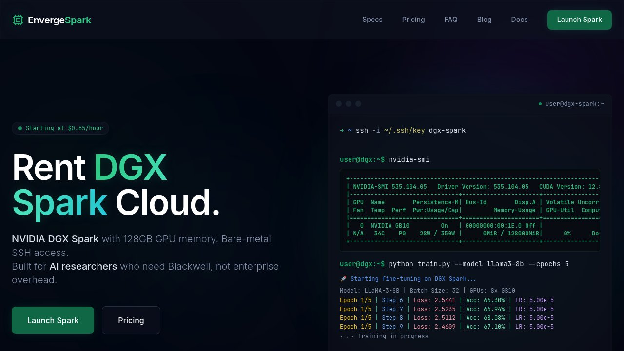
Renting DGX Spark through Enverge Spark Cloud gives you remote SSH and Docker access to hosted NVIDIA DGX Spark hardware. You are not buying the device. You are paying for compute time on a machine Enverge manages.
Current Enverge pricing as of August 2026:
| Configuration | Hourly rate | Memory |
|---|---|---|
| Single DGX Spark instance | $0.75/hour | 128GB unified memory |
| 2× DGX Spark (NVLinked) | $1.65/hour | 256GB unified memory |
No upfront cost. No shipping wait. No hardware to manage. You pay for what you use and stop when you are done.
Rental cost at different usage levels
Here is what Enverge rental costs across common usage patterns:
| Usage pattern | Hours/month | Monthly cost | Annual cost |
|---|---|---|---|
| Light (occasional experiments) | 20 hrs | $15 | $180 |
| Moderate (weekly research runs) | 80 hrs | $60 | $720 |
| Active (daily development, 4 hrs/day) | 120 hrs | $90 | $1,080 |
| Heavy (8 hrs/day, 5 days/week) | 160 hrs | $120 | $1,440 |
| Near-constant (8 hrs/day, 7 days/week) | 240 hrs | $180 | $2,160 |
The practical takeaway: even at heavy utilization, rental costs stay well below the hardware purchase price for the first year. The math only flips when utilization approaches full-time, sustained use over multiple years.
For a full walkthrough of the setup process, see How to Rent an NVIDIA DGX Spark in 2026.
The Breakeven Math: When Does Buying Pay Off?
This is the question most coverage skips. At what utilization level does a $4,699 hardware purchase actually become cheaper than renting?
The calculation is straightforward. Divide the hardware cost by the hourly rental rate to find the raw breakeven in hours.
$4,699 ÷ $0.75/hour = 6,265 hours
That is the pure hardware cost breakeven, ignoring taxes, power, and maintenance. At $0.75/hour, you would need to run the machine for 6,265 hours before the purchase price is "recovered" in avoided rental fees.
Breakeven by utilization scenario
| Utilization scenario | Hours/day | Days/week | Monthly hours | Months to breakeven |
|---|---|---|---|---|
| Low (occasional use) | 2 hrs | 3 days | ~26 hrs | ~241 months (20 years) |
| Moderate (active research) | 4 hrs | 5 days | ~87 hrs | ~72 months (6 years) |
| High (daily development) | 8 hrs | 5 days | ~173 hrs | ~36 months (3 years) |
| Near-constant (always on) | 8 hrs | 7 days | ~243 hrs | ~26 months (2.1 years) |
The honest read: pure hardware cost breakeven takes just over two years of near-constant use. Most AI workloads are not near-constant. Research projects have sprints. Fine-tuning runs happen in bursts. Inference testing is episodic.
The real breakeven is shorter, but so is the risk
Some analyses cite a 2-3 month payback period for buying vs renting. That figure assumes near-full utilization and ignores the hidden costs listed above. Power is a rounding error at roughly $26/year, but sales tax, maintenance overhead, and the opportunity cost of $4,699 tied up in depreciating hardware all push the true breakeven further out.
"If you run AI workloads consistently, you avoid recurring cloud GPU rental bills." That is true. But "consistently" is doing a lot of work in that sentence. If your utilization is bursty, project-based, or uncertain, the math does not favor buying.
What the breakeven math does not capture
Three factors shift the decision beyond pure hours:
- Software compatibility risk. DGX Spark runs on an ARM-based architecture (SM120/SM121). Not all CUDA libraries and AI frameworks support it natively. Some workflows require custom builds, patches, or workarounds. That overhead costs time, which costs money, and it is not reflected in any hourly rate comparison.
- Procurement delay. Hardware availability has been constrained since the LPDDR5X supply shortage drove the price increase. If you need Spark access this week, renting is the only path that works immediately.
- Flexibility. When you own the hardware, you own its fixed capacity. When you rent, you can scale to a 2× Spark configuration with 256GB of unified memory for a larger model run, then drop back to a single instance when you are done.
Who Should Buy DGX Spark?
Buying makes sense when the utilization math works and the ownership model fits your organization. Specifically:
- You need permanent local hardware. On-premise development, air-gapped environments, or data residency requirements that preclude cloud access.
- Your utilization is near-constant. A team running CUDA development 8+ hours a day, 5-7 days a week, will eventually recover the hardware cost, even accounting for power and maintenance.
- You need local peripherals and direct hardware access. Some workflows require physical access to the machine, local display output, or USB-connected devices.
- Your organization requires owned assets. Some procurement frameworks only approve capital expenditure, not operational spend on cloud access.
- You are building a local AI lab. If DGX Spark is the permanent foundation of a research environment, ownership makes more sense than indefinite rental.
The caveat: even if you plan to buy, renting first is worth considering. It costs under $100 to run a month of active development on Enverge. Discovering a software compatibility issue or a workload mismatch before spending $4,699 is a better outcome than discovering it after.
For a deeper comparison of DGX Spark against datacenter GPU alternatives, see DGX Spark vs H100 vs H200.
Who Should Rent DGX Spark?
Renting is the stronger choice when utilization is uncertain, the workload is project-based, or you need access now rather than in 4-6 weeks.
- You are evaluating Spark before buying. Run your actual workload on real hardware for $0.75/hour before committing $4,699 to a purchase.
- Your workload is bursty. Fine-tuning a model takes hours, not months. Running a research experiment has a start and end date. Paying for compute only when you need it is the rational choice for intermittent use.
- You are a researcher or small team. The running research experiments on DGX Spark analysis shows that at $0.75/hour, you can run roughly 5× more experiment variants for the same budget compared to H100 pricing.
- Hardware is out of stock or delayed. Supply constraints have made DGX Spark availability unpredictable. Rental gives you immediate access while you wait for hardware to ship.
- You want to avoid ARM compatibility friction. Some users have reported significant troubleshooting overhead with the DGX Spark's SM120/SM121 architecture. Renting lets you validate your stack before owning the hardware.
- You need 256GB for a specific run. The 2× Spark NVLinked configuration at $1.65/hour gives you 256GB of unified memory for large model work. That is not an option with a single purchased unit unless you buy two.
Bottom line: renting is not always cheaper than buying. But for most AI workloads that are not near-constant, it is the more cost-efficient path. The cheapest way to run a 70B model analysis covers this in detail for teams optimizing on cost per inference.
Buy vs Rent: Full Cost Comparison
| Factor | Buying DGX Spark | Renting via Enverge Spark Cloud |
|---|---|---|
| Upfront cost | $4,699 (plus tax, shipping) | $0 |
| Ongoing cost | Power + maintenance overhead | $0.75/hour (single), $1.65/hour (2×) |
| Setup time | Shipping plus local configuration | Immediate SSH/Docker access |
| Memory | 128GB unified | 128GB (single) or 256GB (2× NVLinked) |
| Access model | Local, physical | Remote bare-metal SSH/Docker |
| Software management | User-managed | Enverge-managed infrastructure |
| Flexibility | Fixed single-unit capacity | Scale up or down by session |
| Breakeven (near-constant use) | ~26 months | N/A, pay per use |
| Best for | Always-on local workloads, on-premise requirements | Bursty workloads, testing, research sprints, pre-purchase validation |
| Hardware availability | Subject to stock constraints | Available now |
FAQ
Is NVIDIA DGX Spark worth buying?
It depends on utilization. At near-constant use (8 hours/day, 7 days/week), the hardware cost breakeven is roughly 26 months. For teams with that level of sustained demand, local ownership, and on-premise requirements, buying is justified. For everyone else, the math favors renting.
How many hours of use justify buying DGX Spark?
At the $0.75/hour rental rate, you would need approximately 6,265 hours of use to recover the $4,699 hardware cost in avoided rental fees. That is just over two years of near-constant use. Add taxes, power, and maintenance, and the threshold is higher.
Can you rent DGX Spark instead of buying it?
Yes. Enverge Spark Cloud provides remote bare-metal access to hosted NVIDIA DGX Spark hardware at $0.75/hour for a single instance. You get SSH and Docker access to the same 128GB unified memory environment, without buying the physical device.
Why did the DGX Spark price increase?
NVIDIA raised the Founders Edition MSRP from $3,999 to $4,699 in February 2026, citing global memory supply constraints affecting the 128GB LPDDR5X unified memory package. The increase applies globally across all regions for hardware purchased through NVIDIA's official channels.
Is renting DGX Spark cheaper than buying?
For most workloads, yes. Renting is cheaper when utilization is intermittent, bursty, or project-based. Buying becomes cost-competitive only at near-constant, sustained use over multiple years. The honest answer is that most AI workloads do not meet that threshold.
What do you get when you rent DGX Spark through Enverge?
You get remote SSH and Docker access to a hosted NVIDIA DGX Spark system with 128GB of unified memory. Enverge manages the infrastructure. You bring your workload. There is no upfront cost and no hardware to manage.
What if DGX Spark is out of stock?
Check other NVIDIA-authorized channels first. If you need access before hardware ships, Enverge rental is available immediately. See Where to Buy NVIDIA DGX Spark for a full channel list.
Next Step
If you are still deciding, the lowest-risk move is to run your actual workload on Enverge before buying hardware. A few hours of testing costs under $5 and answers the questions that no spec sheet can: does your software stack work on the ARM architecture, does 128GB fit your model, and does the throughput meet your needs.
If the answer is yes on all three, you have a much stronger case for the $4,699 purchase. If the answer is no on any of them, you saved yourself a $4,699 mistake.
Launch DGX Spark on Enverge and run a test before committing to hardware.
Before You Submit That CapEx Request
Run your actual workload on Enverge first. A few hours of testing costs under $5 and answers the three questions a spec sheet cannot: does your software stack work on the ARM architecture, does 128GB fit your model, and does the throughput meet your requirements.
If all three check out, you have real utilization data to support the procurement case. If any of them surface a problem, you saved $6,385.
Launch DGX Spark on Enverge and validate before you buy.